Choosing between ductless and central air conditioning affects comfort, energy use, installation needs, and long-term upkeep. The right system depends on your home’s layout, existing ductwork, cooling priorities, and budget. Understanding how each option works makes it easier to choose reliable cooling without paying for features you may not need.
Air conditioning is not a one-size-fits-all decision. A system that works well in one house may be inefficient or unnecessarily expensive in another. Central AC remains a familiar choice for homes with existing ductwork, while ductless mini-splits offer flexible room-by-room cooling without air ducts. When comparing ductless HVAC options for your home with a traditional central system, consider more than the purchase price. Think about your home’s layout, current ductwork, comfort preferences, efficiency goals, and future plans. Looking at these factors together can help you choose a system that provides dependable cooling without adding unnecessary complexity or operating costs overall.
How Ductless and Central AC Systems Work
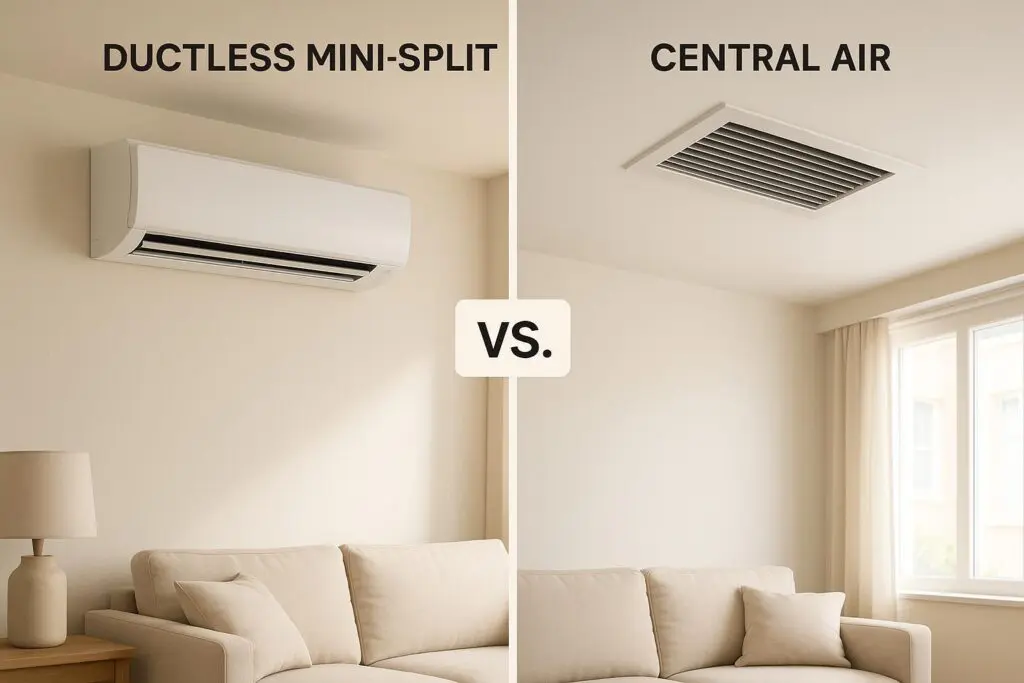
Central air conditioning uses one main system to send cooled air through ducts and vents across the home. It can provide even temperatures when the ductwork is properly sized, sealed, and maintained.
Ductless systems use an outdoor unit connected to one or more indoor units. Each indoor unit serves a room or zone. That makes ductless cooling useful for homes without ducts, additions, converted spaces, or rooms that need separate temperature control.
Consider Your Home’s Existing Setup
Existing ductwork should be one of your first considerations. If your home already has ducts in good condition, central AC may be the simpler choice. A technician should still inspect the ducts for leaks, poor airflow, or sizing problems before new equipment is installed.
If your home has no ducts, adding them can require more construction. Ductless mini-splits avoid that need and usually require less disruption to walls and ceilings.
Compare Comfort and Temperature Control
Central AC works well for households that prefer a fairly consistent temperature throughout the house. Ductless systems offer more room-by-room control, which can be useful when some spaces are used more often than others.
When comparing ductless HVAC options for your home, think about how your family actually uses each room. Zoning can reduce unnecessary cooling in rarely used areas, while central air may feel simpler when the whole home needs similar comfort.
Think About Energy Efficiency and Long-Term Costs
Efficiency depends on more than the equipment label. System sizing, insulation, installation quality, maintenance, and duct condition all affect performance. Ductless systems avoid losses from leaky ducts, while a well-maintained central system can still perform efficiently.
Do not choose only by upfront price. Compare expected operating costs, maintenance needs, and the condition of your existing system. Correct sizing is essential because oversized or undersized equipment can reduce comfort and increase wear.
Look at Installation and Maintenance Needs
Central AC installation can be straightforward when usable ductwork is already in place. If new ducts are needed, the project may become more involved. Ductless systems usually require smaller wall openings, but indoor unit placement still needs careful planning for airflow and appearance.
Both systems need routine care. Keep filters clean, keep outdoor equipment clear, and have unusual noises, weak airflow, or uneven temperatures checked before small problems become larger repairs.
Decide Which System Fits the Home
Central AC often makes sense for homes with sound ductwork and a need for consistent whole-house cooling. Ductless systems can be a better fit when ducts are absent, when only selected areas need cooling, or when separate temperature zones matter.
Before deciding, have an HVAC professional assess the home’s layout, insulation, electrical capacity, existing equipment, and duct condition. A proper evaluation helps prevent sizing mistakes and supports better comfort over the long term.
FAQs
Is ductless AC always more efficient than central air?
Not always. Efficiency depends on the equipment, installation, home design, duct condition, and how the system is used.
Can ductless AC cool an entire home?
Yes. A properly designed multi-zone system can cool several rooms, but indoor unit placement and system sizing must match the home.
Should I replace central AC with ductless cooling?
Only if it fits your home and comfort goals. Good existing ductwork may make central AC the more practical option.
Conclusion
Ductless and central air conditioning can both provide dependable home cooling, but each suits different situations. Central AC often works best in homes with usable ductwork and households that want even cooling from one connected system. Ductless mini-splits offer flexible zoning and can be practical when adding ducts would be difficult or unnecessary.
Before choosing, compare your current HVAC setup, room usage, installation needs, efficiency goals, and maintenance expectations. Professional sizing and installation matter just as much as the system type, so avoid selecting equipment based only on price or advertised capacity. The best choice is the one that matches how your home is built and used. Comparing ductless HVAC options for your home with central air on these practical factors can help you invest in comfort that remains efficient, manageable, and reliable for years.